
Montgomery County Criminal Court Cases
Montgomery County criminal cases share one local records custodian: the elected Clerk of Superior Court. The clerk maintains both District Court and Superior Court files at 108 East Main Street in Troy. District Court tries misdemeanors and infractions and conducts first appearances and probable-cause proceedings in felony matters. Superior Court is the felony trial court. A misdemeanor conviction appealed from District Court ordinarily receives a new trial in Superior Court, so the same matter can leave entries at both court levels.
The official Montgomery County Courthouse page shows the building that houses the local court record counter.
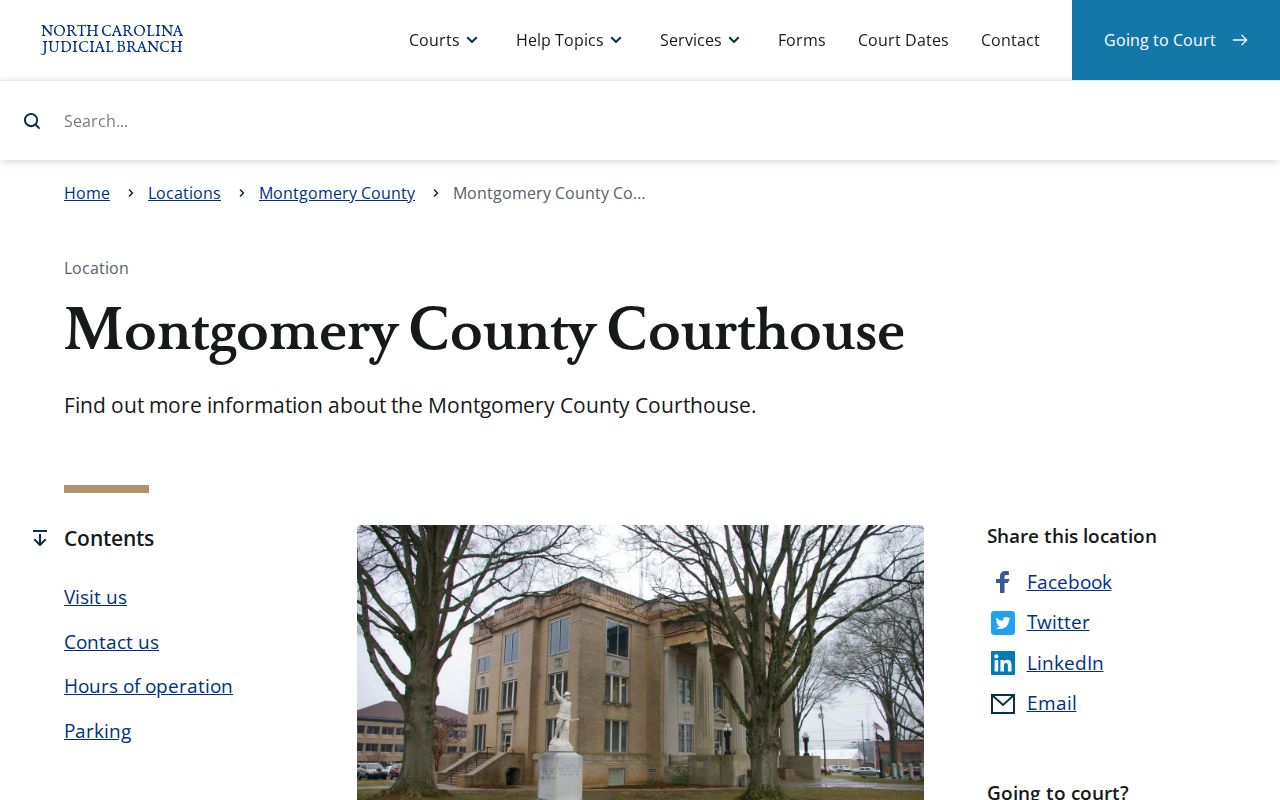
The 1921 Classical Revival courthouse remains the Montgomery County physical records hub even after online indexing arrived. Its location matters because paper documents, public terminals, copies, certified searches, and local procedure still run through the clerk there. Montgomery County does not have a separate district clerk and county clerk split for criminal files.
Montgomery County Court Case Roles
Several offices touch a Montgomery County criminal court case, but they do not hold the same record. Magistrates handle initial process, first-appearance functions, and release conditions. The District Attorney for Prosecutorial District 28 prosecutes for the State and helps prepare Superior Court calendars. Judges decide matters presented in court. The Clerk of Superior Court, not the prosecutor, is the neutral custodian of the complete public case file.
The Judicial Branch contact directory identifies the clerk, judges, prosecutor, and magistrate channels for Montgomery County court work.
Use the role tied to the question. Call the Clerk at 910-571-3700 for a file or copy, the District Attorney at 910-571-3710 for prosecution-office business, and magistrates at 910-572-2866 for their judicial functions. Calling the wrong office can produce a referral instead of the record.
Searching Montgomery County Case Records
The official search sequence combines remote discovery with local verification. Start at the North Carolina eCourts Portal. Montgomery County joined eCourts in October 2024, and every North Carolina county now uses the system. Portal labels can change with Tyler releases, so use the available controls rather than relying on an old screenshot. A file number is more precise than a name. Common-name results need extra care because a name match alone does not establish identity.
- Open Smart Search and choose public case records.
- Enter the complete file number, or use the party's first and last name when the number is unknown.
- Select Montgomery as the county, then narrow by court location, criminal case type, or filing dates when those controls appear.
- Open each matching case and note its charge rows, events, status, disposition, and file number. For a pending matter, also check the Montgomery criminal calendar.
- Call or visit the Clerk to inspect the complete public file and request copies or a certified county search.
| Field label | Type | Required | Use |
|---|---|---|---|
| Record Number | Text | No | Enter a citation or complete case number. |
| First Name | Text | No | Party-name component used with surname. |
| Middle Name | Text | No | Optional control that may narrow a common name. |
| Last Name / Business Name | Text | Conditional | Main party-name field. |
| County | Dropdown | No | Choose Montgomery for local cases. |
| Location | Dropdown | No | Restricts the court location when offered. |
| Case Type | Dropdown | No | Limits results to criminal or another category. |
| Date Filed From / To | Date | No | Sets a filing-date range. |
The Portal is free for Montgomery County case-information discovery, but it is not represented as a certified or comprehensive background product. The Judicial Branch directs a person seeking a county criminal-record search to the Clerk.
The official certified court-search instructions explain that clerk-based route.
A certified Montgomery County criminal-record search costs $25. The research did not identify a local per-page or certification price for ordinary copies, so ask the Clerk for the current amount before ordering.
Missing Montgomery County Case Documents
An online result may identify a Montgomery County case without offering every scanned document. Portal can show a file number, charge, event, and status while the paper file holds the charging instrument, order, judgment, or another filing needed to understand the entry. Financial payment functions may appear for eligible cases, but their presence does not mean the full docket is downloadable.
Write down the file number and ask the Clerk to inspect the public paper or electronic file at the courthouse. The public self-service terminal can search by defendant name, case number, or victim or witness name. Older records and documents not migrated during conversion may be easier to locate there. Paper files are inspected in the county where the case sits. This fallback is also useful when spelling, aliases, or an incomplete date range hide an expected result.
Note: A criminal calendar shows scheduled court activity, not a complete Montgomery County criminal history.
Inside a Montgomery County Case File
A Montgomery County criminal case file is organized around the court's file number and individual charge rows. It can identify the venue, court location, case type, initiation date, defendant, attorney entries, and the State as prosecuting party. Charge data may include the offense description, statute or code, offense date, level, and pending or disposed status. Events can record appearances, probable-cause settings or waivers, continuances, motions, pleas, trials, judgments, and sentencing.
| Case number and court | North Carolina file number, Montgomery venue, court location, case type, and filing date. |
|---|---|
| Parties and counsel | Defendant name, the State as prosecutor, and attorney entries when recorded. |
| Charge details | Description, statute or offense code, offense date, charge level, and current status. |
| Docket events | Appearances, hearings, continuances, motions, plea, trial, and other entered activity. |
| Disposition | Outcome and date at the charge or case level, such as guilty, dismissed, or not guilty. |
| Judgment and sentence | Judgment information, sentence, and financial obligations when publicly available. |
Read each charge separately. One case may contain more than one allegation, and the rows may end differently. A booking charge can also differ from the charge ultimately filed by the prosecutor. For the earlier agency and custody trail, the county's arrest lookup process identifies which office created each record.
Reading Montgomery County Case Outcomes
The disposition is the result of a charge. A conviction means guilt was established by plea or trial and followed by judgment. A dismissal ends a charge without a conviction. An acquittal or not-guilty result means guilt was not established. Pending means no final disposition has been entered. These terms should not be collapsed into a single yes-or-no label.
- Arraignment
- The stage at which charges and the plea are addressed.
- Indictment
- A grand-jury accusation generally used to move felony prosecution into Superior Court.
- Administrative setting
- A case-management court date that is not necessarily a trial.
- Disposition
- The recorded result of a charge, including guilty, dismissed, or not guilty.
- Judgment
- The court's formal decision, including the sentence after a conviction.
A District Court misdemeanor appeal can lead to a new Superior Court trial, which makes the later entries essential. Sentence codes also need context. North Carolina's structured system weighs the offense class, prior-record level, applicable range, and authorized disposition. The judgment and sentencing worksheet, not the charge caption alone, show the actual result.
How a Criminal Case Moves
A Montgomery County felony usually begins with an alleged offense and investigation, then an arrest or other criminal process. A magistrate handles the first judicial steps and release conditions. District Court conducts early felony proceedings. An indictment, when required, moves the prosecution toward Superior Court, where arraignment, case management, motions, a plea or trial, judgment, and sentence may follow. Misdemeanors generally remain in District Court unless appealed.
Case flow: Charges Filed › Arraignment › Pretrial › Plea or Trial › Disposition › Sentencing
Local Superior Court case-management rules direct law enforcement to provide felony case files to the State within ten working days of arrest unless exceptional circumstances apply. That rule helps move prosecution work forward. It does not promise that a public Montgomery County file will be complete within ten days, nor does it set a final hearing date.
Montgomery County eCourts Conversion
Montgomery County went live on eCourts on October 14, 2024, as part of Track 6. The change brought Odyssey case management, eFiling, and public Portal access to local court operations. A planned cutover temporarily paused electronic functions while paper filings received during migration were entered after launch. That history helps explain why a clerk check remains useful for a document created near the conversion or for older material indexed without a remotely available scan.
The Montgomery County conversion changed the search route, not the legal custodian. The Clerk still maintains Montgomery County criminal court records, and courthouse terminals and paper files remain official access channels. Portal is the best first pass for a case number. The local counter is the next step when an event label is unclear, a document is absent, or a certified record is needed.
Federal Cases Outside Montgomery eCourts
A federal charge connected to Montgomery County does not appear as a state criminal case in the county eCourts file. Montgomery County lies in the U.S. District Court for the Middle District of North Carolina. Federal docket access runs through PACER and the federal clerk, while state felony and misdemeanor files remain with the Montgomery County Clerk of Superior Court.
The official PACER service is the registration and search channel for federal case records.
The separate federal route prevents a false conclusion when a state search returns nothing. The staffed Middle District clerk location is in Greensboro, and the official district court site provides current office information. PACER requires an account and may charge fees, while courthouse terminals and judicial opinions have separate access rules.
Case Record Access & Restrictions
North Carolina G.S. 7A-109 generally opens records in the Clerk's custody to inspection, subject to other laws and court rules. Remote display can still be narrower than the courthouse file. Confidential juvenile matters are excluded, protected personal identifiers are redacted, and sealed or expunged material does not remain in ordinary public channels.
If a Montgomery County case does not appear, confirm the spelling, file number, county, date range, and court level. Then ask the Clerk whether the record is older, non-migrated, confidential, expunged, or available only through the local file. The Judicial Branch record-access instructions cover online case information, public terminals, paper files, copies, and remote-data access.
An expunction starts with the clerk in the county where the charge or conviction occurred. Eligibility is statute-specific. A dismissed charge is not automatically absent the day it ends, and investigative agencies may retain certain records when the law permits.