
Checking Criminal History in Montgomery County
Begin with the source that answers the question. The North Carolina eCourts Portal is useful for finding a Montgomery County case number, charge row, hearing, or disposition. The Clerk of Superior Court is the next stop when a paper file, terminal-only detail, copy, or certified county search is needed. Current jail custody requires a call to detention staff because no official county roster was found. A statewide fingerprint file is available only to the person whose record it is through the SBI Right to Review process.
Before searching, gather the full name, any prior or maiden name relevant to a self-review, an approximate birth year, and the county where the event occurred. A name alone is weak proof. Compare the file number, age or birth data when shown, charge date, and court location before deciding that a result belongs to the right person.
- Search the North Carolina eCourts Portal by name or file number and set the county filter to Montgomery.
- Open the case and note its complete file number, charge status, court division, and next event.
- Call or visit the Clerk when a remote document is missing, the case predates migration, or the result needs formal verification.
- Contact the creating police agency for an incident report and the detention center for current custody.
- Use SBI Right to Review for a fingerprint-supported check of your own North Carolina history.
Montgomery Criminal Records Across Systems
One event can produce five distinct Montgomery County records. Police or deputies write the incident and arrest report. Detention staff create the booking entry. A magistrate records initial process and release conditions. The Clerk maintains the court file as charges move through District or Superior Court. If fingerprints are taken, the arresting agency sends that event to NCSBI, and a later court disposition may be linked to the same fingerprint-supported cycle.
The practical flow is: incident or arrest → booking → magistrate process → court case → disposition reported to NCSBI. Each record answers a different question. A jail charge shows why custody began, while the filed court charge and charge-level disposition show what prosecutors pursued and how the court resolved it. Delays and unmatched identifiers can leave one system behind another.
For the official shared court route used by all three towns, the Montgomery County Judicial Branch page shows the county services and eCourts entry points.
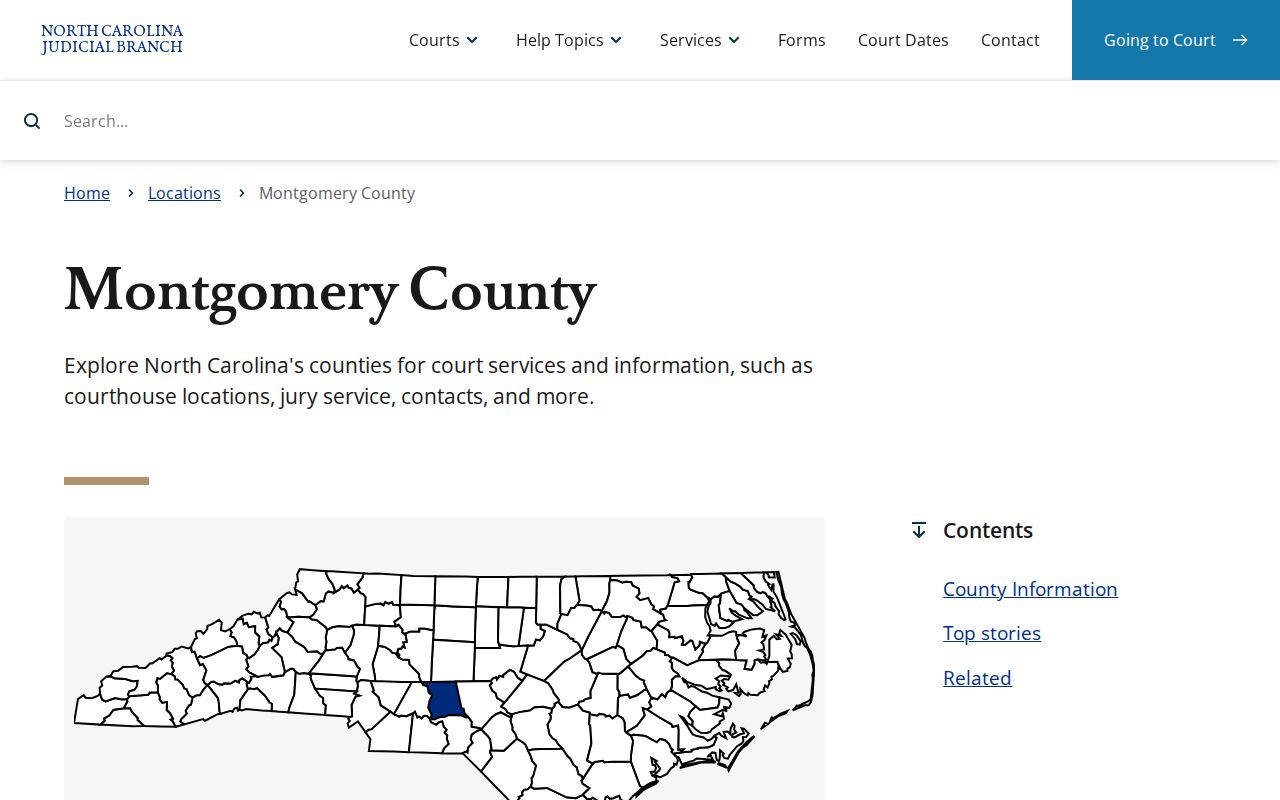
The image reinforces a key local fact: Troy, Biscoe, and Mount Gilead criminal matters all route into the unified county court system.
North Carolina Official Background Checks
The North Carolina State Bureau of Investigation, Criminal Information and Identification Section, keeps the central fingerprint-based criminal history repository. It does not offer a general public name-search product. For self-review, a person submits the SBI form by mail with a complete FD-258 ten-print card and a certified check or money order. The result covers fingerprint-supported North Carolina arrest cycles and linked dispositions available to SBI, not a national history.
Montgomery County residents can obtain fingerprints at the Sheriff’s Office on Wednesday or Thursday from 11:00 a.m. to 1:00 p.m. The published local fingerprint fee is $10. Call first to confirm identification rules and whether a card is supplied. The FBI Identity History Summary is the separate subject-only route for a national file.
The official SBI Personal Review page explains the choices and mail process.
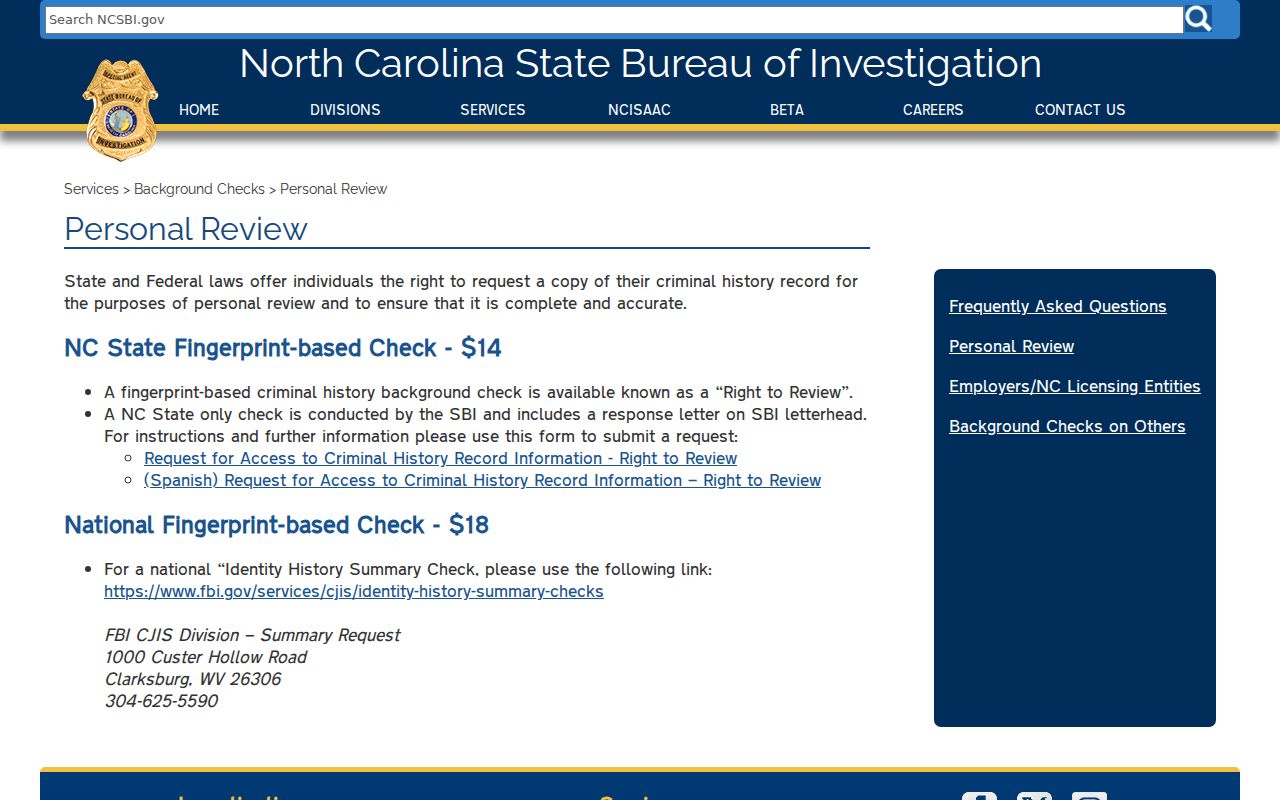
This source shows why a fingerprint and direct request, rather than an open name box, define the state self-review channel.
Montgomery eCourts Records After 2024
Montgomery County joined eCourts on October 14, 2024. Portal search is now the natural discovery step, but it is not a promise that every old paper or scanned document can be viewed remotely. The Clerk remains important for pre-conversion material, public-terminal results, and documents not migrated to online display. The Judicial Branch also directs people who need a formal county criminal-record search to the Clerk.
| Portal field | Best use | Required |
|---|---|---|
| Record Number | Direct lookup with a complete citation or file number | No |
| First, Middle, Last Name | Party search, with middle name used to narrow common names | Conditional |
| County | Restrict results to Montgomery County | No |
| Location or Case Type | Narrow court site and criminal category where offered | No |
| Date Filed From and To | Limit a broad search to a useful filing period | No |
Interface labels can change with Tyler releases. Save the complete file number from a useful hit, then use it when speaking with the Clerk. A county criminal calendar can show an upcoming setting, but it is not a full criminal history.
Criminal Record Types
Montgomery County criminal records are divided by the office and stage that created them. An incident report describes what an agency received or investigated. Booking data records intake and custody. The court file tracks charges, hearings, rulings, judgment, and financial obligations. The SBI file groups fingerprint-supported arrest events and reported outcomes. NCDAC data concerns state prison and community supervision, while the state registry covers only people subject to sex-offender registration law.
- Incident and arrest report: held by the sheriff, town police, or other agency that handled the event.
- Booking record: created at the Montgomery County Detention Center and limited to custody-related facts.
- Criminal case file: kept by the Clerk for District and Superior Court proceedings.
- SBI criminal history: a fingerprint-supported state record available for personal review.
- Corrections or registry file: a purpose-specific state record, not a substitute for the court judgment.
Federal records form another layer. The Middle District of North Carolina serves Montgomery County, and federal cases do not appear in the state eCourts file.
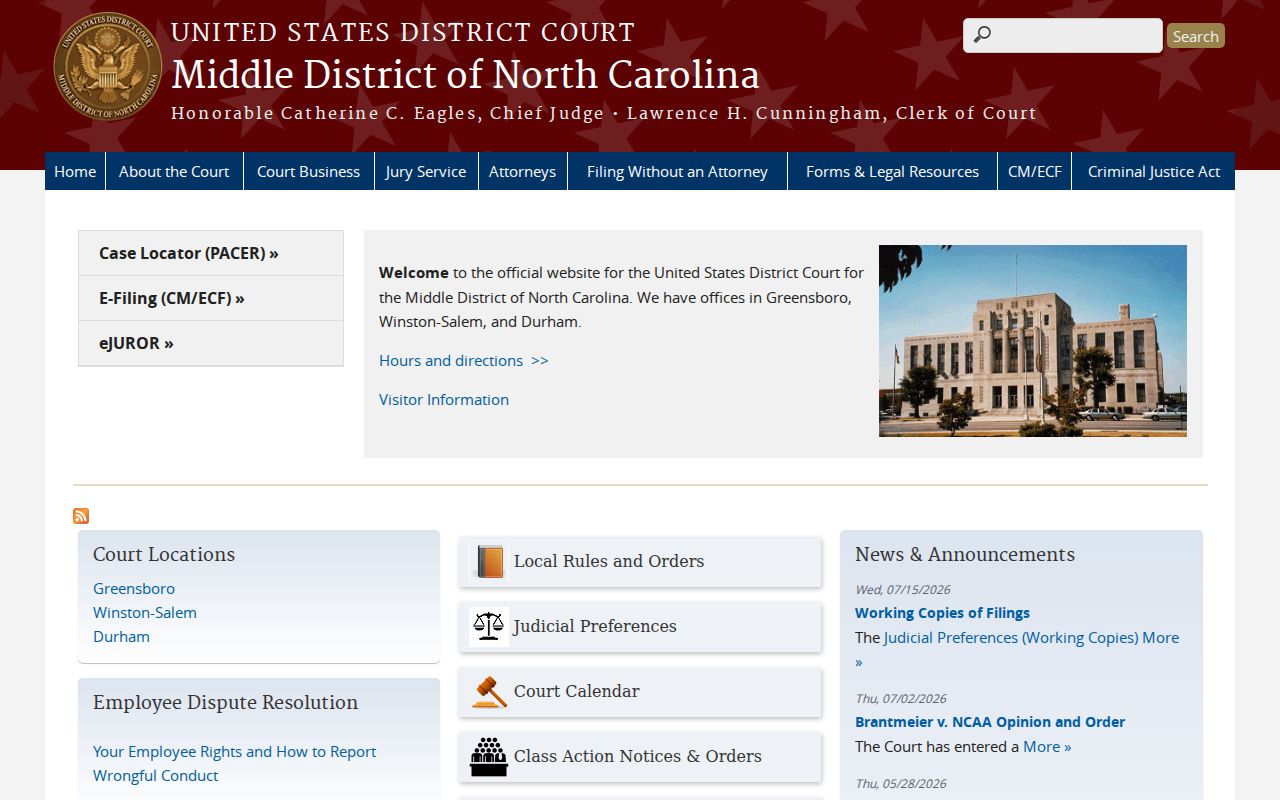
The federal court image marks the boundary between local North Carolina cases and the separate federal docket system.
Montgomery Jail Records Without a Roster
No official Montgomery County online inmate roster, arrest blotter, or booking log was located. For immediate custody, call the Montgomery County Detention Center at 910-576-4261. Staff can explain what identifying details are needed. NC SAVAN and VINELink may provide participating custody-status notifications, but neither should be treated as a full historical arrest search.
The detention center at 206 Glen Road in Troy is a 106-bed maximum-security adult facility built in 2009. It houses men and women, including some participants in the statewide misdemeanor-confinement program. That means a person held there is not necessarily awaiting a new Montgomery County trial. Southern Correctional Institution is a separate state prison, and the NCDAC offender search does not replace a call about county pretrial custody.
A past arrest requires a broader chain. Ask the arresting agency for public arrest facts, check the Clerk’s case file for prosecution and outcome, and use SBI Right to Review when reviewing your own fingerprint history. The dedicated Montgomery County arrest lookup explains those local routes in more depth.
Inside a Montgomery County Criminal Record
The contents depend on the source. An SBI record begins with identity fields and groups arrest cycles by date, agency, charge, and matched disposition. A court file is built around the file number, venue, parties, charges, events, orders, disposition, judgment, and eligible payment information. Booking records focus on admission and custody. Read the field label before drawing a conclusion.
| Name and Identifiers | Names, aliases, birth data, descriptive fields, and state or federal identifiers as law permits. |
|---|---|
| Arrest and Booking | Arresting agency, date, booking number, initial charges, bond or hold, and present custody data. |
| Charges | Offense description, statute or code, offense date, level, and pending or disposed status. |
| Court Events | Appearances, settings, motions, plea, trial, continuances, and orders entered in the file. |
| Disposition | The result for each charge, such as guilty, dismissed, or not guilty, with a date when entered. |
| Sentence or Supervision | Judgment terms and public prison, probation, post-release, or parole entries in the proper system. |
Confidential juvenile matters and protected identifiers do not belong in public display. A blank remote document field can also mean that a paper file or terminal inquiry is needed, not that the event never occurred.
Montgomery Court Records at the Courthouse
The Montgomery County Courthouse at 108 East Main Street in Troy remains the physical records hub. The Clerk’s main number is 910-571-3700. Visitors can use a public self-service terminal, ask to inspect a paper criminal file, request copies, seek a certified county search, or file an expunction petition. Superior Court hears felony trials. District Court handles misdemeanors and the early stages of felony cases.
The building also gives the records system a distinct local setting. Completed in 1921, the tan-brick Classical Revival courthouse has a Doric portico, pediment, and clock. A 1976 interior remodeling changed courtroom fixtures while retaining classical wall elements, and the courthouse entered the National Register in 1979. Digital access did not erase this counter-based fallback.
Clerk of Superior Court
108 E. Main St., Troy, NC 27371
910-571-3700
Case files, terminals, copies, certified searches, and expunction filings.
Sheriff's Office
111 W. Main St., Troy, NC 27371
910-572-1313
Weekdays, 8:00 a.m. to 5:00 p.m.; sheriff reports, warrants, and fingerprints.
Detention Center
206 Glen Rd., Troy, NC 27371
910-576-4261
Current county custody and booking-information questions.
Montgomery Criminal Record Fees Compared
Cost follows the product, not the name being checked. Portal discovery and inspection at the Clerk’s public terminal are free, while a certified Montgomery County court search costs $25. The Sheriff lists a $10 fingerprint service. SBI charges $14 for a mailed Right to Review, and the FBI’s subject-only Identity History Summary carries an $18 federal fee before any added fingerprint or channeler cost.
| Record service | Verified fee | Access route |
|---|---|---|
| eCourts Portal search | Free | Online public discovery |
| Clerk certified county search | $25 | Clerk of Superior Court |
| Montgomery Sheriff fingerprints | $10 | Published Wednesday and Thursday service |
| SBI Right to Review | $14 | Mail with FD-258 card and certified funds |
| FBI Identity History Summary | $18 federal fee | Electronic or mail subject request |
No general sheriff report-copy fee or Montgomery courthouse per-page copy price was found in official sources. Ask the custodian before ordering rather than assuming that a fee from another town or county applies.
Public Access Laws in North Carolina
North Carolina law separates open court records and specified arrest facts from protected investigative material. The Clerk generally permits inspection of court files in its custody, subject to statutes and court rules. A police custodian can release the public facts of an incident or arrest while withholding protected investigative narrative, juvenile information, private identifiers, and certain victim or witness details.
Key statutes:
Chapter 132 defines public records broadly while preserving statutory limits and redaction.
G.S. 132-1.4 protects investigative records but makes listed incident and arrest facts public.
G.S. 7A-109 generally opens records held by the Clerk for inspection.
G.S. 15A-146 governs qualifying dismissed and not-guilty expunctions, including specified automatic relief.
A precise sheriff or police request should name the event date, place, incident number if known, requested record category, and preferred format. Ask separately for the public incident facts, arrest facts, report, booking material, CAD data, audio, or photograph. If part is withheld, ask for the legal basis and any separable public portion.
Montgomery Warrant Records by Phone
The Sheriff’s Field Services division serves arrest warrants, subpoenas, forfeiture papers, and domestic-violence protective orders, but Montgomery County has no verified public active-warrant list, Most Wanted page, app-based warrant tool, or separate hotline. Portal may reveal court events. It is not advertised as real-time confirmation of all active process.
Use the Sheriff’s main office at 910-572-1313, non-emergency dispatch at 910-571-7107, magistrates at 910-572-2866, and the Clerk at 910-571-3700. Ask for the issuing court, file number, process type, and current instructions. An order for arrest can follow a failure to appear or comply, while a search warrant may remain sealed during an investigation. Do not assume that one local check clears process in another county or state.
MontgomerySO, the official free iOS sheriff app, supports public outreach, crime reports, and tip submission. Its public description does not confirm warrant, inmate, registry, or copy-order tools. Emergencies still go to 911.
Sealed, Expunged, and Restricted Records
North Carolina uses both expunction and expungement for statutory removal of qualifying records. Juvenile files follow separate confidentiality rules. Protected identifiers can be redacted without closing a whole public file. Even after an expunction, limited confidential agency or prosecutor access may remain where statutes allow, and certain investigative records may be retained. Relief does not mean that every piece of paper vanishes from every system at once.
G.S. 15A-146 covers qualifying dismissed and not-guilty charges. It also provides specified automatic relief after final disposition for eligible cases, subject to exclusions. Other statutes cover some convictions, with rules based on offense type, record pattern, waiting period, and statutory bars. A Montgomery County petition is filed with the Clerk where the charge or conviction occurred. The general filing fee is $175, though qualifying dismissed or not-guilty petitions are often fee-free unless diversion or deferred prosecution led to dismissal.
The Judicial Branch expunction page organizes routes, forms, fees, and filing guidance.
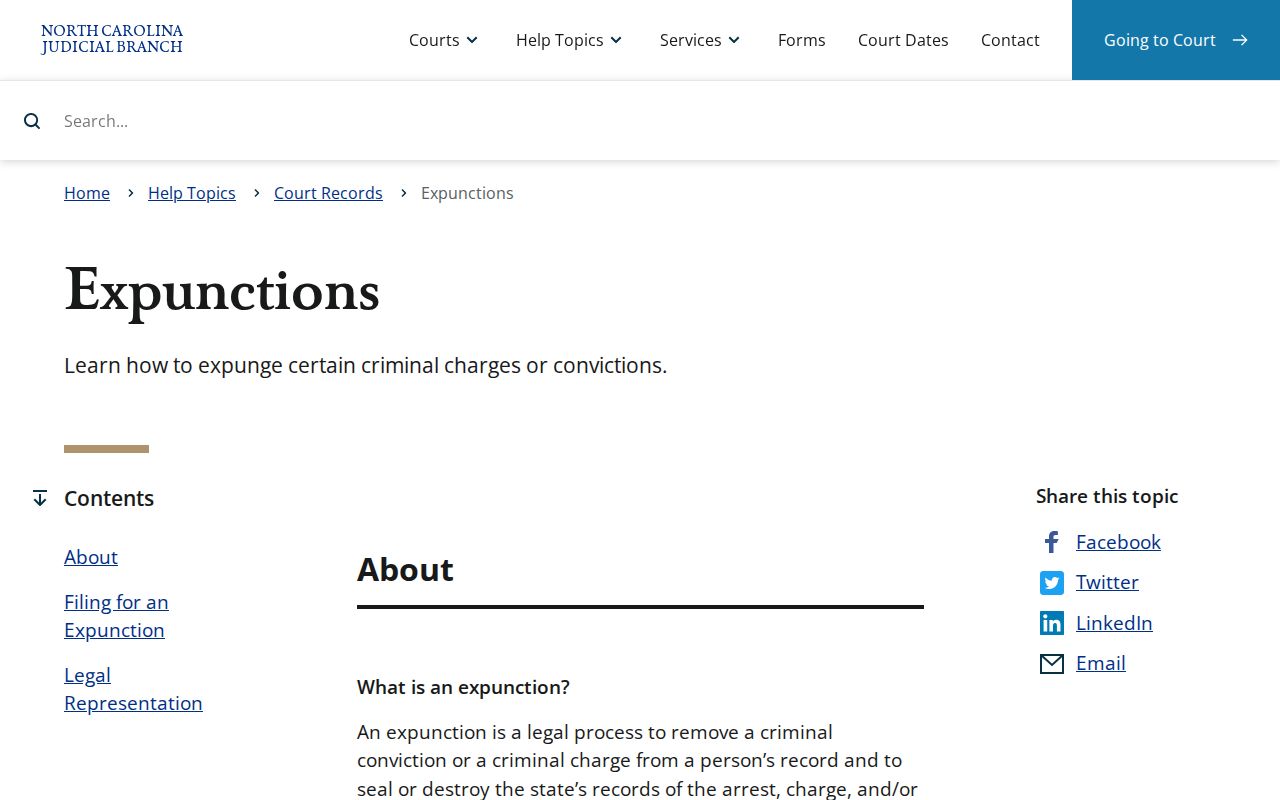
The table helps a filer identify the correct category before choosing a petition, since Montgomery County relief has no single universal waiting period.
The related official expunction form search provides the current AOC form families.
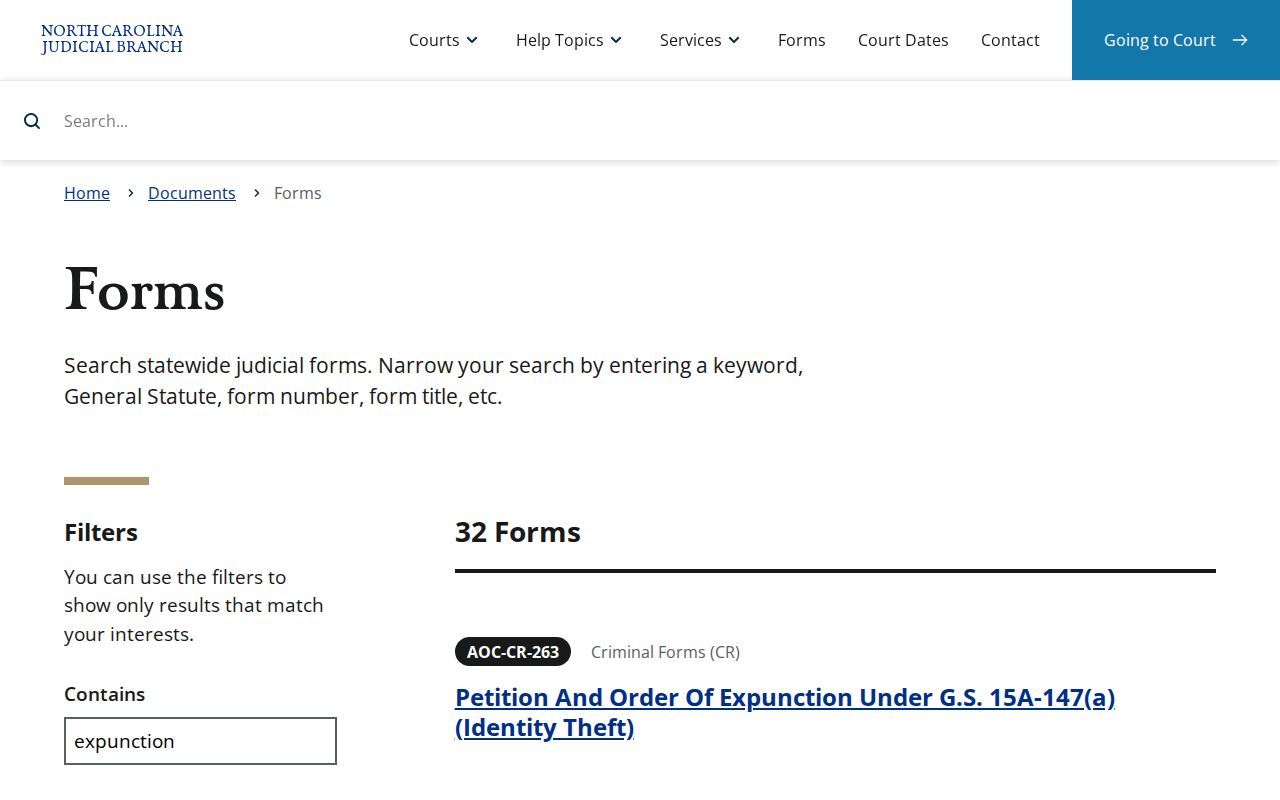
The form catalog is the safer source for a current petition than an old saved copy or a form written for another state.
Montgomery Police Records Stay Local
A town police report does not automatically become a sheriff report. Troy Police holds reports for events it handled inside Troy. Biscoe Police is the city custodian for Biscoe incidents. Mount Gilead Police handles its own reports at 123 North Main Street. State Highway Patrol retains the records for its enforcement and crash work. After an arrest, county detention and court records can exist alongside that agency file, but they do not replace it.
Local procedures differ. Mount Gilead publishes in-person report copies for $10 during weekday counter hours, with five business days allowed for crash reports and two to three for other incident reports. Biscoe’s official policy lists $5 accident-report copies paid through Town Hall, followed by ID and receipt presentation at the police department. Troy’s official Report Request page currently shows no working form or instructions, so direct contact is the documented fallback.
The Mount Gilead report instructions show the most detailed town-level process in the county.
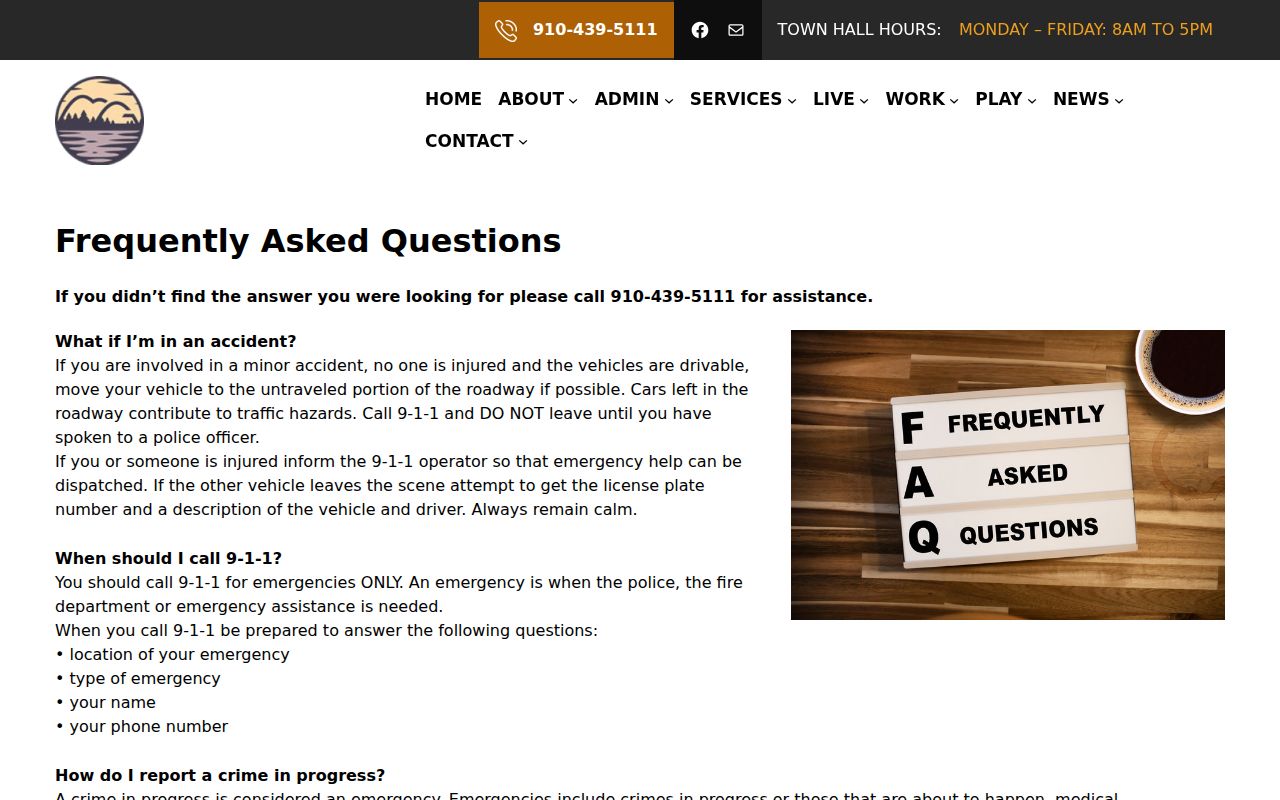
The town source illustrates why the creating police department, not a general county search, is the first stop for an incident copy.
Montgomery Criminal Record Terms
Short status labels can change the meaning of a record. Read the charge-level result, not just the arrest line or case heading. North Carolina court entries also distinguish release terms, hearings, judgments, and sentencing choices that may look alike in a result list.
- Disposition
- The final result of a charge, such as guilty, dismissed, or not guilty.
- Order for arrest
- North Carolina process directing custody, often after failure to appear or comply.
- Administrative setting
- A scheduled case-management date, not necessarily a trial.
- Prior record level
- The calculation used with the felony class in structured sentencing.
- Community, intermediate, active
- Sentencing categories often shortened to C, I, and A on state punishment charts.
A dismissal ends a charge without conviction, but it does not always erase all related entries at once. An acquittal means guilt was not established. A pending charge has no final outcome. If systems disagree, the signed judgment or dismissal in the Clerk’s file is the best starting document for correction.
Montgomery Crime Records in Context
Montgomery County had 25,751 residents in the 2020 Census and an estimated 26,403 in 2025. In the NCSBI 2024 annual summary, the county’s Index Crime rate fell from 1,847.3 per 100,000 in 2023 to 1,436.1 in 2024. Violent crime fell from 458.9 to 274.8, and property crime fell from 1,388.5 to 1,161.3 per 100,000.
Those figures yield calculated declines of about 22.3 percent for Index Crime, 40.1 percent for violent crime, and 16.4 percent for property crime. They describe reported county-level patterns, not the history of a named person, the safety of a street, or the outcome of a particular case. Rates in a smaller county can also shift sharply when the underlying number of events changes by a modest amount.
For an individual record question, return to the agency file, detention entry, court case, SBI response, or NCDAC result that directly answers it.
Montgomery County Criminal Records by City
Troy, Biscoe, and Mount Gilead are the three largest incorporated places in Montgomery County under the state’s 2024 estimates. Each police department creates its own incident and arrest reports. None has a separate municipal criminal court or long-term jail. Arrested adults route to the county detention center, while citations and criminal cases move through District or Superior Court in Troy and the statewide eCourts system.
Troy Criminal Records
Population estimate 3,145. Start with Troy Police for city reports, then use county detention and court channels.
Biscoe Criminal Records
Population estimate 1,881. Biscoe Police holds town reports, while Montgomery County handles booking and court files.
Mount Gilead Criminal Records
Population estimate 1,180. The police department publishes distinct report fees and processing times.