
Sex Offender Checks in Montgomery County
The North Carolina Sex Offender and Public Protection Registry is the main public source for a Montgomery County sex offender search. The North Carolina State Bureau of Investigation maintains the system. County sheriffs register people, verify required facts, and send their entries to the state system. This split matters. The public portal lets a reader find and compare published records, while the Montgomery County Sheriff handles local registration questions, apparent noncompliance, and corrections that require agency review.
Choose a search route that fits the question. A nearby-address search supports awareness near a home, school route, or family destination. A name search is useful when several other identifiers are already known. The Montgomery County filter gives county-wide results, and a registration number can lead to a specific file. None of these methods produces a full list of sex-offense convictions. The registry contains only people whose cases and present duties place them within North Carolina registration law.
The official NCSBI registry landing screen shows the state entry point used for Montgomery County checks.
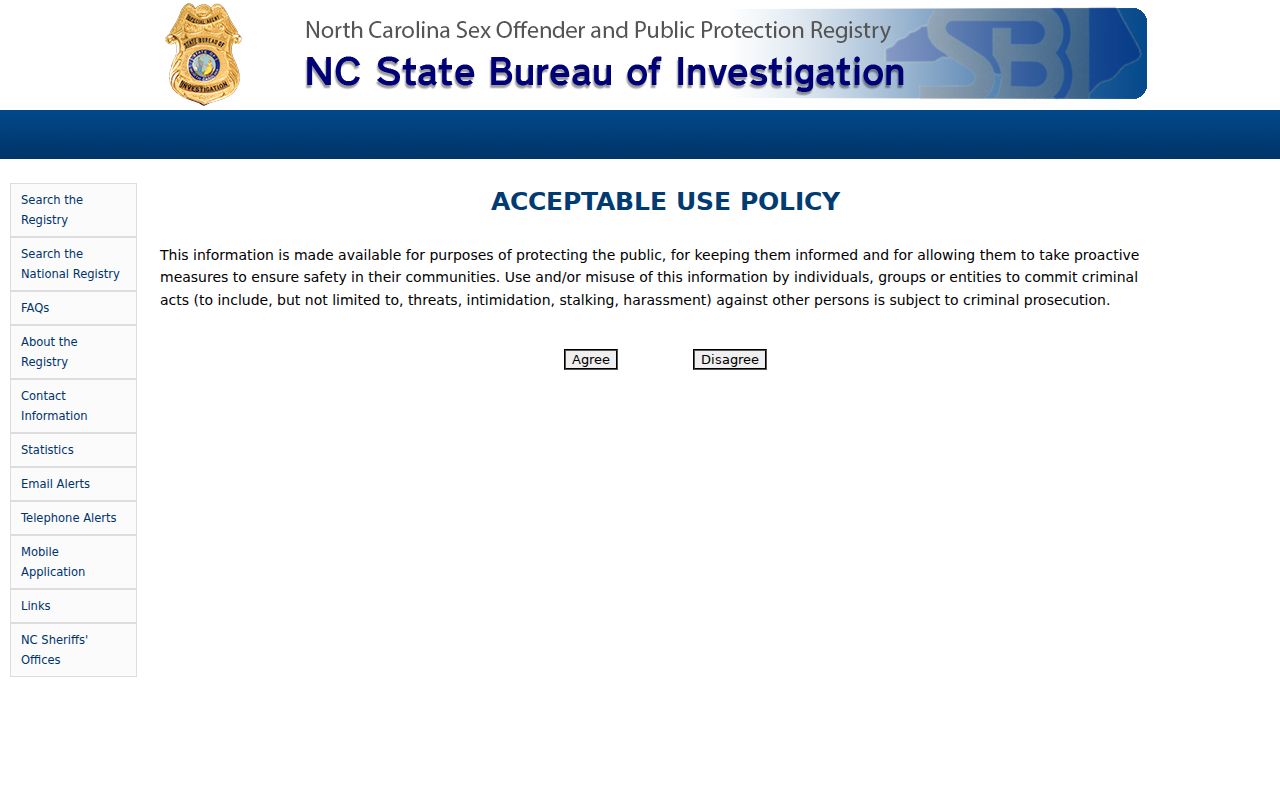
That state interface is the discovery layer, while local questions still belong with the Montgomery County Sheriff.
Montgomery County Registry Search Routes
Before entering a query, write down the narrow facts that can be checked without guesswork. A full name may yield more than one result. An address may be stale or may describe a place tied to a statutory status rather than the location a reader expects. City, ZIP code, physical description, photograph, and qualifying-offense facts help separate one person from another. Coordinate search is also available for a valid North Carolina location, but live radius choices can change with the interface.
County statistics and downloadable public data are separate tools. Statistics summarize sheriff-entered records and are not a substitute for opening a current profile. NCSBI cautions that processing delays and entry errors can affect counts, and pending-status records may be left out of reported totals. Treat a count as a snapshot of the system, not proof about one address or person.
How to Search the North Carolina Sex Offender and Public Protection Registry
The state portal supports several paths into Montgomery County registry records. Start broad enough to avoid a spelling miss, then narrow only with facts that can be checked. Search controls may shift as NCSBI updates the interface, so read the live labels before submitting.
- Open the NCSBI public registry and read its conditions and safety notice.
- Select a nearby-address, name, county, coordinate, or registration-number search.
- Enter Montgomery County or the other known location fields, then run the query.
- Open a possible profile and compare several identifiers before drawing a conclusion.
The registry name and location search illustrates the controls available for a focused Montgomery County query.
The form supports more than a name match, which is why location and profile review are key safeguards.
| Search field | Type | Required | Use |
|---|---|---|---|
| Nearby an address | Address form | Conditional | Street, city, ZIP, and live distance workflow for a valid North Carolina place. |
| Name | Text | Conditional | First and last name components; profiles may also show aliases. |
| City or ZIP | Text or select | No | Narrows a name or location query. |
| County | Dropdown | No | Select Montgomery for county-wide results. |
| Latitude and longitude | Numeric | Conditional | Supports coordinate-based nearby searching. |
| Sex Registration Number | Text | Conditional | Opens a query tied to a known registration identifier. |
Montgomery County Registry Limits
A clear Montgomery County registry result has a narrow meaning. It shows that the public system associates the profile with a current or reported registration duty. It does not summarize every arrest, charge, dismissal, or conviction in a person’s life. It also cannot prove that every person convicted of a sex offense must appear. Article 27A contains qualifying rules, categories, dates, and court decisions that shape who registers and for how long.
Data timing adds another limit. Sheriffs enter and verify local information, then the statewide system publishes authorized fields. A move, status update, correction, or pending record may not appear at the moment a reader expects. Never turn a missing search result into a claim that no duty exists. For a public record that appears wrong, note the registration number and the exact field, then contact the Montgomery County Sheriff or NCSBI rather than trying to fix it through repeated searches.
The official county statistics interface makes the source and timing limits visible without focusing on a private individual.
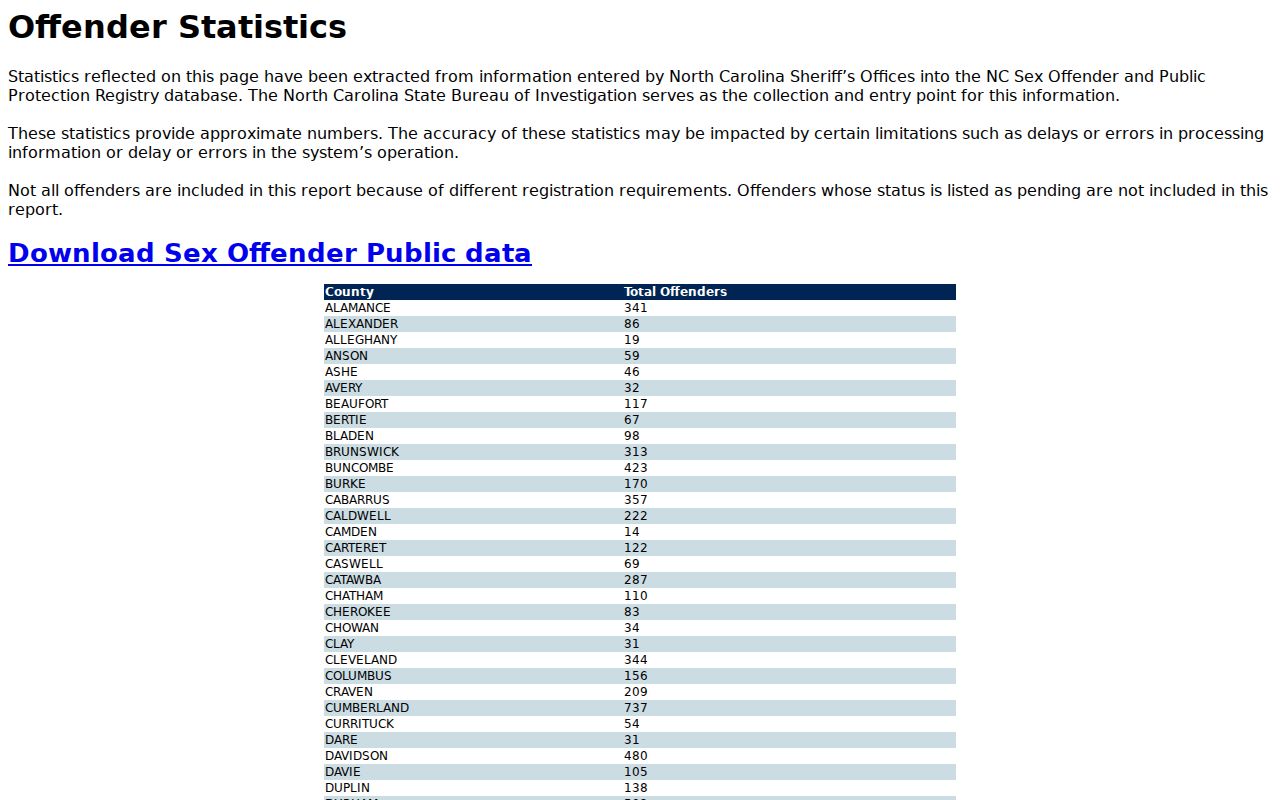
Those Montgomery County totals are context only and should not be read as a live profile count for a specific place.
Inside a Registry Profile
Open the profile before relying on any result. The public view may pair a name with aliases, a photograph, physical details, an address or location, county, registration dates, verification facts, and qualifying-offense information. Fields vary by record and legal authority. A blank public field does not show that law enforcement lacks that information. It only shows that the item is not visible in that profile at that time.
| Name and aliases | Published identity names used to compare a possible match, not a safe basis by themselves. |
|---|---|
| Photo and description | Photograph plus authorized traits such as sex, race, height, weight, hair, eyes, and birth information. |
| Address and county | Reported public location information and the county tied to registration. |
| Offense details | Qualifying offense description or statute, conviction date and place, and authorized victim-related categories. |
| Registration facts | Registration number, status dates, verification information, and category-linked details when shown. |
| Other authorized fields | Scars, marks, tattoos, vehicles, or institutional information may appear when collected and public by law. |
Compare at least two or three strong identifiers. A common name, rough age, or neighborhood alone can point to the wrong person. If details conflict, stop and seek official clarification.
Montgomery County Sheriff Registry Role
Montgomery County registrants report through the Sheriff’s Office at 111 West Main Street, Troy, NC 27371. The main number is 910-572-1313. Published office hours are weekdays from 8:00 a.m. to 5:00 p.m. Official county sources do not list a separate registry appointment line, registry fee, or a more specific counter schedule. Calling first is prudent when the question concerns an appointment or a record correction.
The Sheriff is also the sound route for apparent noncompliance. Give the office the profile’s registration number, the public fact that raised concern, and the observed date or place. Do not investigate or confront the person. A reader who sees an immediate threat should use emergency channels; a routine data question belongs on the main office line. The statewide NCSBI system remains the public search source, but sheriff verification is what gives Montgomery County entries their local foundation.
Note: A profile discrepancy should be reported with specific facts, not treated as proof that a registrant violated a duty.
North Carolina Registration Levels and Requirements
North Carolina does not reduce its public registry to a simple Tier I, II, and III chart. Article 27A divides registration into programs and categories. Part 2 generally carries a 30-year period, with a possible petition after ten years for an eligible person who meets statutory and federal conditions. Part 3 covers sexually violent predators, recidivists, and aggravated offenses with lifetime registration. Juvenile and out-of-state situations follow their own rules.
| Category | General duration | Visibility and verification context |
|---|---|---|
| Part 2 registration | Generally 30 years from initial county registration | Public registration applies; eligible people may petition after ten years, but relief is not automatic. |
| Part 3 categories | Lifetime | Sexually violent predator, recidivist, and aggravated-offense rules have category-specific duties. |
| Juvenile registration | Set by statute and court, with maximum and termination rules | Not every juvenile adjudication creates a public registration record. |
| Out-of-state, student, or worker | Depends on presence, status, and underlying duty | The Sheriff should confirm the North Carolina obligation rather than relying on another state’s label. |
Verification frequency also depends on the governing category and status. A public profile should be read with its dates and category facts, not forced into a tier label the state does not use as its sole framework.
Montgomery County Cross-State Registry Checks
The NCSBI registry is strongest for North Carolina records and local Montgomery County filtering. The National Sex Offender Public Website is the better second layer when a safety question crosses state or tribal lines. NSOPW federates participating public registries. It does not turn them into one uniform database, so differences in state law, field display, and update timing remain.
The official NSOPW search interface shows the national path that complements a Montgomery County search.
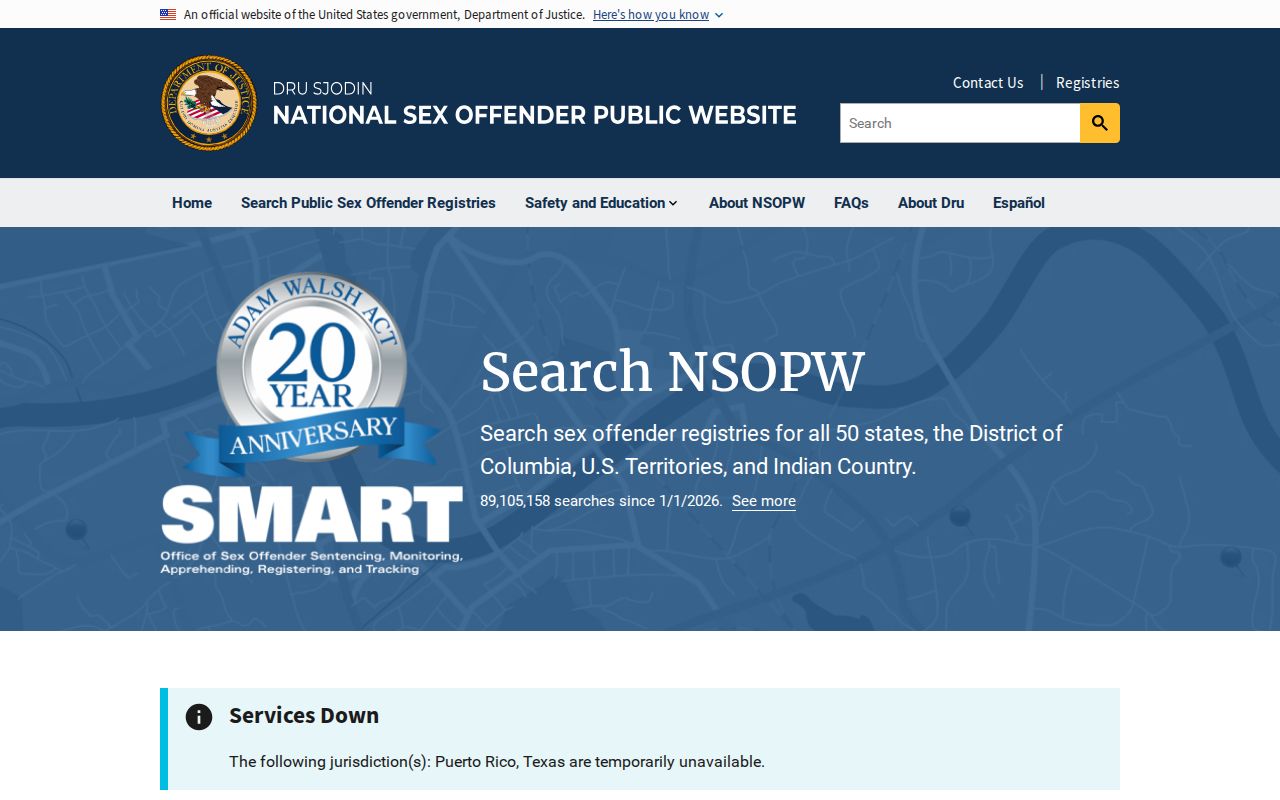
A careful cross-state review opens the originating jurisdiction’s profile and applies that jurisdiction’s labels instead of assuming North Carolina categories control.
Email alerts on the state interface can support ongoing awareness tied to a place. VINELink may separately offer custody or status notifications for participating records. These are distinct services. An alert does not replace a current profile review, and a custody update does not establish registry compliance. Use each tool for the event it actually tracks.
Montgomery County Registry Restriction Context
G.S. 14-208.18 imposes place restrictions on specified registrants and specified locations. It is not a single blanket radius that applies in the same way to every Montgomery County profile. The person’s legal category and the kind of place both matter. A map pin cannot answer that legal question by itself.
For community safety, use the nearby-address search as an awareness tool. Then read the profile and the live statute before making assumptions. If a location appears to conflict with a duty, report the facts to the Sheriff. Local law enforcement can assess status, exemptions, dates, and facts that a public map cannot show. Personal action based on an unverified map result risks both error and harm.
Montgomery County Registry and Federal Custody
A Montgomery County registry search and a federal custody search answer different questions. The NCSBI registry publishes authorized information about people subject to registration duties in North Carolina. The Federal Bureau of Prisons locator covers federal inmates from 1982 forward and can show a name, register number, age, race, sex, release date, and location. It does not replace the state registry, and a result marked released or not in BOP custody does not rule out another form of custody or supervision.
The official Federal Bureau of Prisons inmate locator provides the separate federal-custody search described in the Montgomery County research.
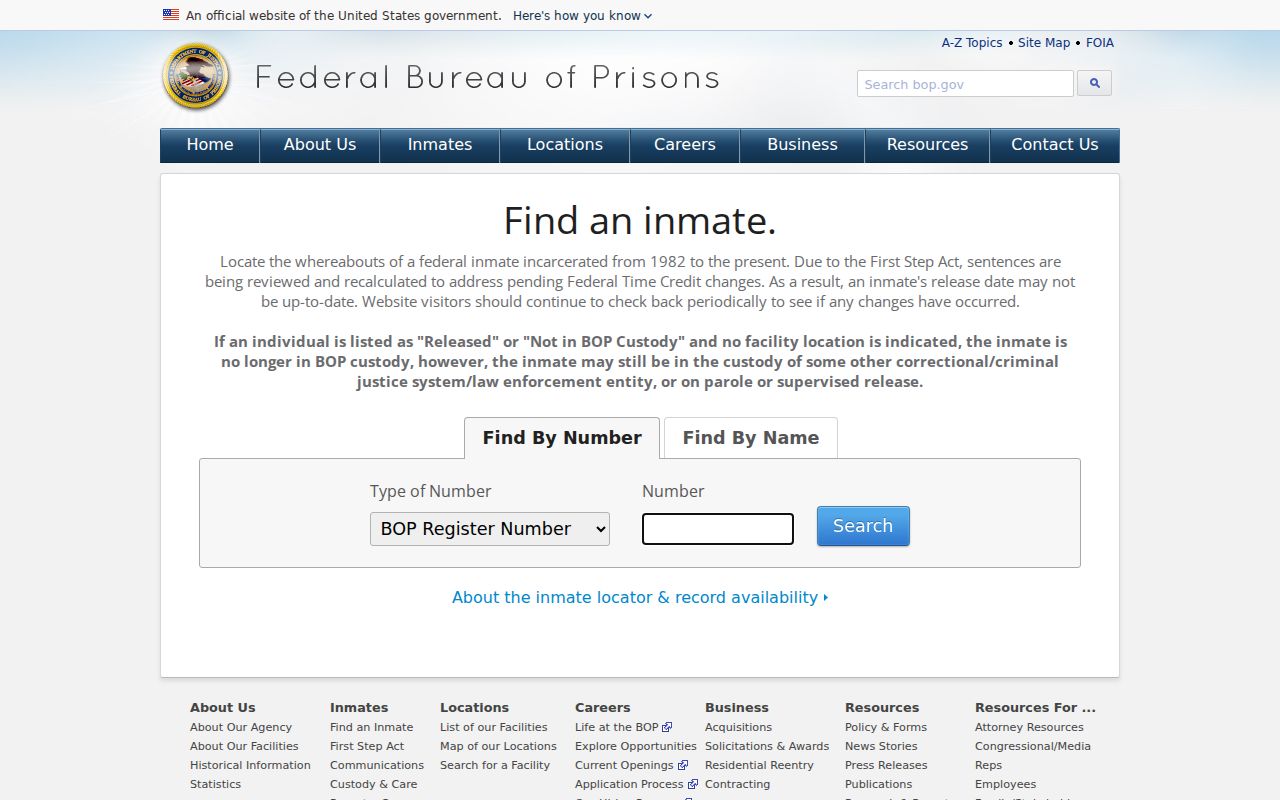
Use that federal tool only for custody context, then return to NCSBI for current North Carolina registration information.
Community Notification and Lawful Use
Registry information is published for public protection, community awareness, and sensible safety planning. Lawful use starts with accurate identification. It also means avoiding threats, harassment, intimidation, or direct attempts to enforce registration rules. Apparent noncompliance belongs with the Montgomery County Sheriff or NCSBI. A profile should never be used as a pretext for vigilantism against a registrant, family member, or household.
G.S. 14-208.15A provides the public registry access framework. Read it with Article 27A and the warnings displayed by NCSBI. Public access does not grant permission to misuse the data.
Misuse is a crime: G.S. 14-208.15A makes misuse of registry information to threaten, intimidate, or harass a registrant or another person a criminal offense.
Keep the search tied to safety. Confirm matches, respect the limits of each field, and let the agencies charged with verification handle suspected violations.